
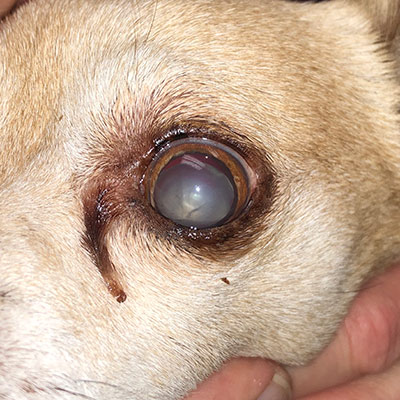
Lens Luxation Treatment for Dogs and Cats
The most common problem with the lens of the eye is a cataract, and the second most common is lens luxation, which means the lens has moved out of its normal position. At Animal Eye Clinic, Dr. Robert M. Gwin, who wrote early articles defining primary lens luxation in dogs, diagnoses and surgically treats lens luxation at our Tulsa and Oklahoma City offices.
Request an AppointmentWhat Is Lens Luxation?
The lens is held in place by thousands of tiny zonular fibers attached around its outer edge. These fibers are not normally visible. Changes in tension on these fibers allow the eye to focus for near and far vision, a function that is much more developed in people than in pets, likely because pets lack the fovea or macula that gives humans sharp reading vision.
Lens luxation occurs either as an inherited condition, often seen in terrier breeds, or secondary to other disease. The lens can luxate in advanced glaucoma, where the eye physically enlarges, or as a result of inflammatory diseases such as uveitis, which has many causes. Hypermature cataracts can also weaken the supporting fibers.
Anterior vs. Posterior Lens Luxation
The lens can move backward, called a posterior lens luxation, or forward, called an anterior lens luxation.
Posterior Lens Luxation
A posterior luxation is generally a more benign process. The lens often falls back into the lower portion of the vitreous at the back of the eye, which may allow some return of vision. These eyes still need monitoring for inflammation and pressure changes.
Anterior Lens Luxation
When the lens moves forward into the anterior chamber, it is a much more serious problem. An anterior luxation can block the flow of aqueous humor through the pupil and trigger a secondary glaucoma called pupillary block glaucoma. The lens can also press against the cornea and damage the endothelial cells on its inner surface, leading to corneal edema similar to endothelial dystrophy. Anterior lens luxation should be treated as an emergency.
Lens Luxation Surgery
In general, if a lens luxates anteriorly, surgical removal of the lens is recommended to prevent these complications. An anterior lens luxation can be readily removed with an intracapsular extraction, in which the lens is removed in one piece within its outer membrane, or lens capsule. This is a very successful procedure. With the lens removed, the visual axis is clear, and many pets keep a comfortable, reasonably visual eye even without a lens. Learn more about our surgical procedures.
Lens Luxation FAQs
What causes lens luxation in dogs?
Lens luxation is often inherited, especially in terrier breeds, but it can also result from glaucoma, uveitis, trauma, or hypermature cataracts.
Is lens luxation an emergency?
An anterior lens luxation is an emergency because it can quickly cause painful glaucoma and corneal damage. Call us right away if you suspect it.
What are the signs of lens luxation?
Signs include a sudden red, painful, or cloudy eye, squinting, tearing, a visible lens edge in the pupil, or a change in vision.
How is anterior lens luxation treated?
Surgical removal of the lens through an intracapsular extraction is usually recommended and is a very successful procedure.
Can my pet see without a lens?
Yes. Many pets have a comfortable and reasonably visual eye after lens removal, even without a replacement lens.
Will the other eye be affected?
Inherited lens luxation often affects both eyes, so the other eye should be monitored closely.
Get Prompt Care for Lens Luxation
Call (918) 632-0508 (Tulsa) or (405) 751-3821 (Oklahoma City) if your pet shows signs of a displaced lens or a painful eye.