Ectopic Cilia Treatment for Dogs
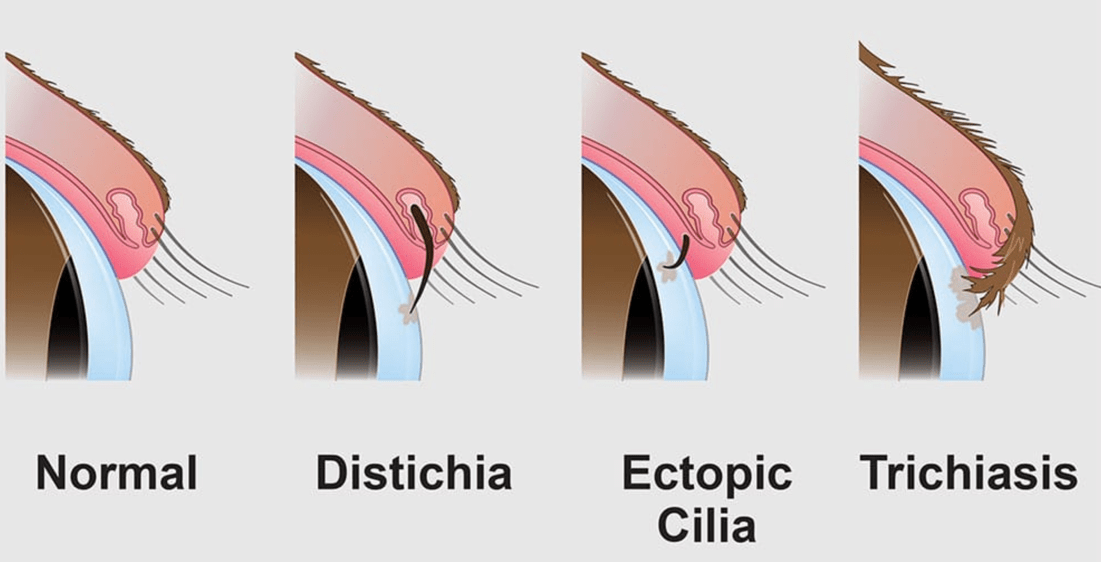
Ectopic cilia are out-of-position eyelashes that grow from the base of the meibomian gland follicle and come out through the inner conjunctival surface of the eyelid, putting them in direct contact with the eyeball. At Animal Eye Clinic, Dr. Robert M. Gwin surgically removes ectopic cilia under an operating microscope, bringing pets immediate relief.
Request an AppointmentWhy Ectopic Cilia Are So Irritating
Because ectopic cilia rub directly against the eye each time the eyelids open and close, they cause varying degrees of irritation. Squinting, tearing, redness, and corneal ulceration are all possible. Ectopic cilia are typically located in the central to paracentral region of the upper eyelid, several millimeters from the lid margin, and are often seen as a “nest” of 6 to 12 eyelashes in a compact bundle.
Ectopic cilia are related to distichia, which also originate from the meibomian glands but exit along the eyelid margin. Because ectopic cilia are hidden on the inside of the eyelid, they can be easy to miss without a specialized eye exam, and they are a common cause of painful ulcers that won’t heal in young dogs.
Ectopic Cilia Surgery
Dr. Gwin surgically removes ectopic cilia using an operating microscope. A small plug or wedge of conjunctiva and underlying tissue is removed with a small surgical blade, and the area is then frozen with a 3 mm cryoprobe to destroy the abnormal follicle producing the lashes. Relief is instantaneous, and recurrence is extremely rare. Learn more about our surgical procedures.
Ectopic Cilia FAQs
What are ectopic cilia?
Ectopic cilia are eyelashes that grow through the inner surface of the eyelid and rub directly on the eye.
How are ectopic cilia different from distichia?
Both come from the meibomian glands, but distichia exit along the eyelid margin while ectopic cilia exit through the inner eyelid surface.
What are the signs of ectopic cilia?
Signs include squinting, tearing, redness, and corneal ulcers, often in the upper part of the cornea.
How are ectopic cilia treated?
Dr. Gwin removes the lashes and surrounding tissue under an operating microscope and freezes the follicle with a cryoprobe.
Will my pet feel better after surgery?
Yes. Relief is usually instantaneous once the lashes are removed.
Can ectopic cilia come back?
Recurrence is extremely rare after surgical removal and cryotherapy.
Get Relief for Your Pet’s Painful Eye
Call (918) 632-0508 (Tulsa) or (405) 751-3821 (Oklahoma City) to schedule an exam with Dr. Gwin.